AnyBoard
Version 9 Installation Guide
Please see the install.txt file in the AnyBoard package for updated
information
Installation has been made even easier in version 9.
Estimated time: 5 minutes.
 AnyBoard
Web installer
use this to install AnyBoard and AnyEmail free version on your site.
AnyBoard
Web installer
use this to install AnyBoard and AnyEmail free version on your site.
If you are setting up Windows IIS, please refer the link below on how
to setup PERL for IIS
http://aspn.activestate.com//ASPN/Reference/Products/ActivePerl/faq/Windows/ActivePerl-Winfaq6.html
Quick
Install Guide
1) Upload abicons/ folder to your web root
folder
2) Upload the abmasterd/ folder to your web server, change its permission
to make it writable
3) Edit anyboard.cgi: set the $abmain::master_cfg_dir to
the path of abmasterd/
4) Install anyboard.cgi to
your cgi-bin, then access the script with the URL below and follow
the instructions
http://your-host/your-cgi-dir/anyboard.cgi?cmd=init
|
Detailed
          Instructions for new AnyBoard users
 System
requirements
System
requirements
AnyBoard can be
installed on web servers which supports CGI, including UNIX, Linux and
Windows NT/2000. The basic requirements for AnyBoard are
- CGI access.
Your server must allow you to install your own CGI scripts. Normally,
the CGI scripts are installed under a directory named cgi-bin/, cgi-local/,
cgibin/, scripts/, etc. Consult your ISP on this.
- PERL 5.004
and up.
Your ISP should
have a FAQ page answer questions such as CGI access and perl scripts.
Always consult your ISP if not sure.
Download
AnyBoard Free Version (links directly to AnyBoard.zip file), unzips
it, you will find a script file named anyboard.cgi, which is the AnyBoard
program.
Installation procedures
| 1
FTP the abmasterd/ folder and the abicons/ folder
to your web server (trivial)
|
After you unzip the anyboard.zip file, you will see the following files
and sub folders

As the first step,
you upload both the abmasterd/ and abicons/ folders (include
their sub folders) to your web server. If you have telnet access to
the server, you can ftp the anyboard.zip file and unzip it on the server,
otherwise, you need to unzip the AnyBoard package and upload the folders
using FTP.
A) The abmasterd/ folder contains the AnyBoard functions code
(the file AnyBoardOne.pm), and samples configuration filea which can
be used as templates. This folder will also contain the password file
for the AnyBoard System Admin (master admin), it should be placed outside
of your web tree, so it's not directly accessible via the browser. Transfer
all files in binary mode. Make sure abmasterd/ is writable by the CGI
user.
On UNIX, the command
"chmod 777 abmasterd" will make it writable. On Windows, only the server
admin can change the directory permissions.
B) The abicons/
folder is just for the default icons used by AnyBoard. Upload the abicons/
directory and all image files and sub folders to your web root.
Make sure it's at the right place, for example, http://your-domain.com/abicons/folder.gif
should show a folder icon, if not, then you have installed the folder
at the wrong place. Make sure the formicons/ sub folder is also uploaded.
You should to able to see http://your-domain.com/abicons/formicons/cut.gif
.
| 2
Edit and install the anyboard.cgi script
(Pay attention now) |
Set the following required parameter in the anyboard.cgi script
$abmain::master_cfg_dir
This is must be set to the path of abmasterd/ installed in step I.
Examples:
$abmain::master_cfg_dir = "/home/user/mysite/abmasterd";
$abmain::master_cfg_dir = "e:/inetpub/abmasterd";
You can use relative path for the directory, for example,
$abmain::master_cfg_dir = "../../abmasterd";
If you are not sure about the paths, you can install and run the getinfo.cgi
script to examine your server settings.
Now, install the anyboard.cgi (FTP in ascii mode) to your /cgi-bin/,
make sure the script is set to the right permissions. You may need to
consult your web host's FAQ on how to install PERL cgi scripts. Open
your browser and point to the anyboard.cgi script on the server
(http://your-site-url/your-cgi-dir/anyboard.cgi), if you set the $abmain::master_cfg_dir
correctly and the abmasterd/ folder has the right permissions, you should
see a form asking you to create a master administrator for the AnyBoard
system.
| 3 Follow
the online setup wizard (Pay attention
now) |
After master_cfg_dir
is set correctly, AnyBoard will prompt you to create a master administrator,
who has control of all AnyBoard forums.
After creating
the master admin, AnyBoard will prompt you to login as the master. Once
logged in, you enter the master admin panel. At this point, AnyBoard
will create one forum automatically, the forum is listed as Master Forum
on the admin panel. But this is a special forum resides in the master_cfg_dir
and may not be under the web tree.

To create new forums,
click on the create new forum link on the master admin panel. Simply
follow the online instructions. With most Apache servers setups,
this will just work, and you can skip the rest of this section.
If you have
problems,
then go back to the master admin panel, clicking on the "Examing
system settings" link and read the information in the comments
area carefully. You may have to set additional parameters, which can
be done by either edit the anyboard.cgi script or through the "Reconfigure
settings" link.
Most web servers supports something called PATHINFO, and AnyBoard takes
advantage of that to determine the physical locations of folders automatically.
However, on servers which do not provide correct support for PATHINFO,
you need to tell AnyBoard not to use it. This is done by setting the
$abmain::no_pathinfo in the script to 1. Now, you have 3 additional
parameters to set.
$abmain::no_pathinfo = 1;
$fix_top_dir: the
web directory which will contain all forums, must be writable
$fix_top_url: the URL of the $fix_top_dir
$fix_cgi_url: the URL of the AnyBoard script itself
|
Configuration
|
What it is |
Examples |
| $master_cfg_dir |
Where site configuration information
is stored. Must be writable. |
UNIX:
$master_cfg_dir="/home/anyboard/abmasterd";
Windows:
$master_cfg_dir="D:/inetpub/abmasterd";
|
| $fix_top_url |
Top URL of the directory which contains
all forums.. |
$fix_top_url="http://anyboard.net/anyboard/";
|
| $fix_top_dir |
Directory for the top url
above. Must be writable. |
UNIX:
$fix_top_dir = "/home/netbula/www/anyboard/";
Windows:
$fix_top_dir="D:/inetpub/www/anyboard/";
|
| $fix_cgi_url |
Full url of the AnyBoard CGI script. |
$Fix_cgi_url=
"http://anyboard.net/cgi-bin/anyboard.cgi";
$fix_cgi_url=
"http://251.222.123.234/scripts/anyboard.pl";
|
A correctly configured script's sinfo page looks like the following:
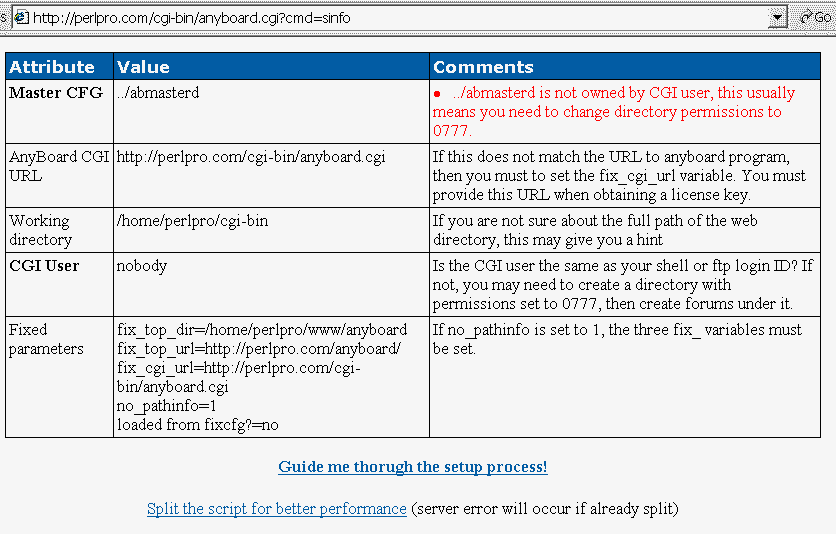
Once these variables are configured correctly, you
will see the Create new forum page. Just fill in the relevant information,
and your forum will be created.

You will be then directed to the new forum's admin
panel:

The very first thing you need to do is to set a admin password:

| 4 Request
license key (registered version only) |
If you are installing a non-free version of AnyBoard, you need to obtain
and enter a license key, otherwise, the forum admin panel will be missing
the configuration sections and certain admin functions will not be activated.
To request a key,
login the master admin panel, and click on the "Set license key" link,
you will see the anyboard.cgi url and a long string of letters and digits
in square brackets, email both the url and the info in square brakets
to sales@netbula.com to obtain a license key. You don't need a license
key for the free version.
If you do the above, you have a forum running, you should start configuring
the forum, such as changing admin login and password. AnyBoard has over
300 configuration parameters, see the AnyBoard manual for details.
| 5 Additional help needed? |
If you can get
the step 1) to display the sinfo page and can't go beyond that, please
submit an installation
request, and we will have a look. If your system requires special
treatment, we may install AnyBoard on your site for free (you need to
provide login/password to your site), otherwise, you may order the installation
service from us.
